
Insights · Hitting & development
The Brewers Didn't Win With Ground Balls. They Won With Complete Hitters.
The Brewers’ approach to ground balls, opposite-field hitting, launch angle and contact points challenges some of the most popular assumptions in modern hitting development.
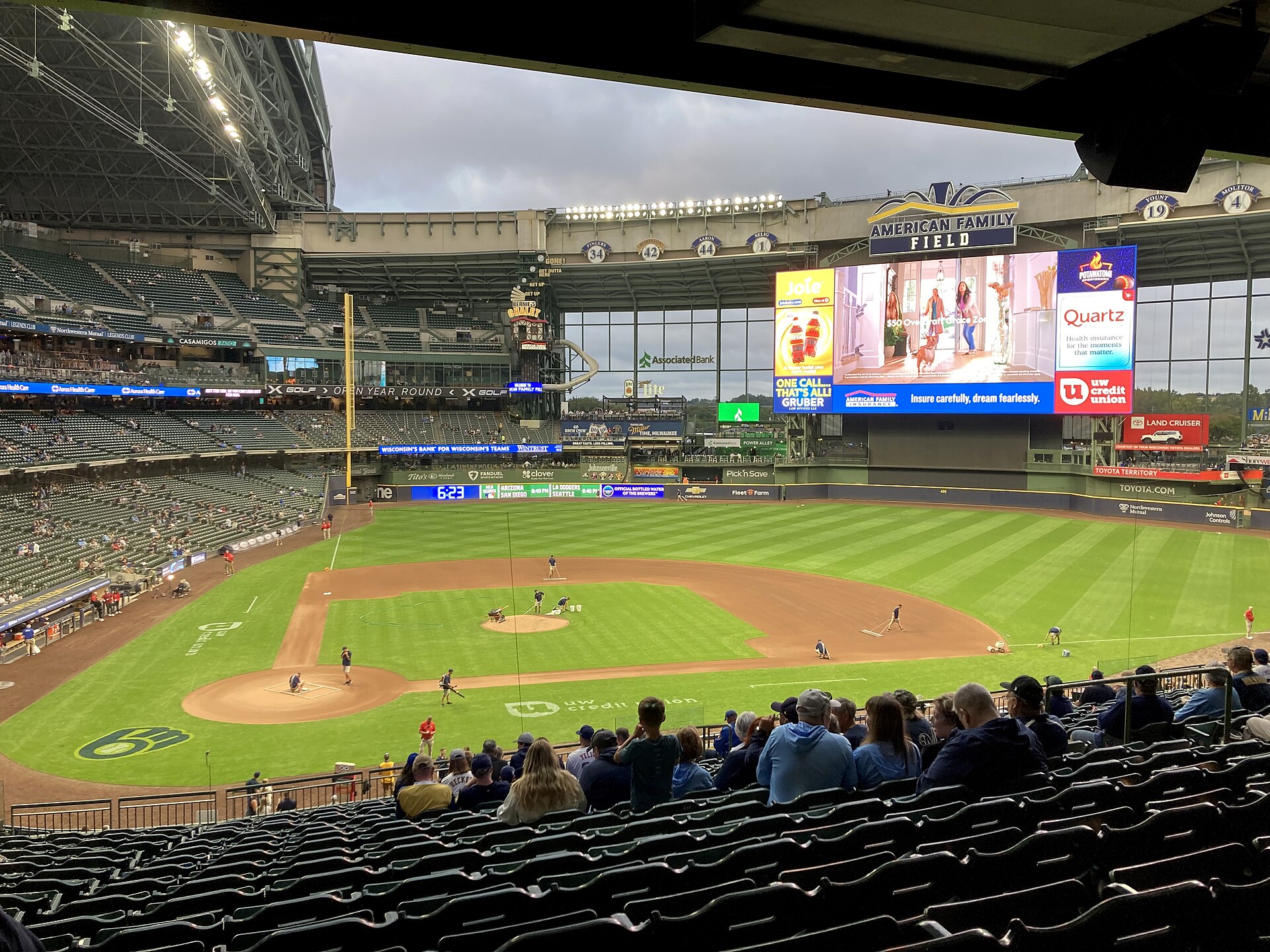
Photo: Michael Barera, American Family Field, September 2025. Licensed under CC BY-SA 4.0.

For most of the last decade, the hitting message has been simple: get the ball in the air, pull it, hit it hard. Ground balls became a mistake to fix. The opposite field became the place you went when you were late.
Then the 2026 Milwaukee Brewers won 103 games and the first World Series in franchise history, beating Tampa Bay in five games, and they did it while breaking nearly every one of those rules [1][9].
That doesn’t mean the rules were all wrong. It means it’s time to ask an uncomfortable question: Has modern hitting instruction become so focused on launch angle, exit velocity and pull-side power that we’re overlooking how complete hitters are built?
What Milwaukee actually did
These are the Brewers’ final 2026 regular-season numbers, checked against the original data:
| 2026 regular season | Brewers | MLB rank (of 30) | MLB average |
|---|---|---|---|
| Ground-ball rate | 48.1% | 1st (highest) | 42.4% |
| Opposite-field rate | 27.0% | 1st (highest) | 24.0% |
| Pull-side air rate (pulled line drives, fly balls and pop-ups) | 12.4% | 30th (lowest) | 18.4% |
| Average launch angle | 9.2° | 30th (lowest) | 13.9° |
| Average bat speed | 72.6 mph | 5th (fastest) | 72.1 mph |
| Chase rate | 29.1% | 30th (lowest) | 32.9% |
| Strikeout rate | 22.0% | 17th lowest | 22.1% |
| Batting avg. / On-base pct. | .258 / .341 | 1st / 1st | .244 / .318 |
| Runs scored | 832 | 2nd | 726 |
| Home runs | 154 | Tied for 2nd-fewest | 186 |
Sources: Baseball Savant batted-ball and Statcast leaderboards (first four rows) [10][11]; FanGraphs team batting (bat speed through home runs) [12]. Averages are team averages.
Look at two lines in particular. Milwaukee had the flattest launch angle in baseball and the fifth-fastest bats. This was not a team of slap hitters. They swung hard. They just didn’t swing hard at everything, and they didn’t swing on one path.
Contradiction #1: Ground balls vs. launch angle
The obvious headline is “the Brewers hit ground balls.” That’s true and misleading.
Manager Pat Murphy addressed it directly in September: “We’re certainly trying to hit home runs. We’re not cutting our swing down to create ground balls” [4]. Verducci, reporting on the Brewers’ hitting staff, wrote that they don’t try to hit ground balls. They try to hit line drives, and they don’t want the ball sky-high off the bat [1].
So the ground balls were a consequence, not the goal. A flatter, line-drive swing will produce more grounders than an uppercut. That’s the trade-off for a path that stays on plane with more pitches.
The data supports the trade-off, with a caveat:
| Batting average on ground balls, 2026 | Pulled | Opposite field |
|---|---|---|
| MLB | .205 | .415 |
| Brewers | .214 | .452 (119 hits) |
Source: Baseball Savant Statcast Search, 2026 regular season [13].
A grounder the other way is twice as likely to be a hit as a pulled one. But Milwaukee still hit roughly 3½ times as many pulled grounders (922) as opposite-field grounders (263). And Petriello notes that most teams with ground-ball rates near Milwaukee’s over the last decade had poor offenses [3]. The ground ball didn’t win. The swing that produced it did.
This is where I think we’ve gotten confused. We took an ideal outcome, a ball driven in the air, and turned it into an ideal swing. Those aren’t the same thing.
Contradiction #2: The opposite field vs. pull-side power
Pulling the ball in the air is the most valuable contact in baseball. MLB.com’s Mike Petriello notes it’s also the hardest to do, and the Brewers did less of it than any team [3].
What they did instead was let the ball travel. Petriello found the Brewers made contact deeper than all but one team, about 29 inches in front of the hitter. They were also the only team whose bat path was angled toward the opposite field at contact [3]. Verducci’s final-season numbers show the same thing [1][2].
There’s a reason that matters now. Verducci reports that average four-seam velocity has climbed from 94.3 mph in 2015 to 96.3 mph in 2026, thrown from lower release points [2]. Catching that pitch out front, which is what pull-side lift requires, keeps getting harder.
Milwaukee hitting coach Daniel Vogelbach put it plainly: “Barreling balls is great, but staying inside and staying through balls, that gets you hits. If you start cheating to the fastball trying to barrel it, you’re really in trouble” [1].
Contradiction #3: Adaptability vs. one prescribed swing
The most important lesson may be the least visible one. Milwaukee didn’t hand its hitters one swing.
Before the season, Vogelbach described the staff’s job as delivering one team message, from Murphy, in different ways: “[E]very player and every hitter is different… Some guys may want the message to be delivered to them in a mechanical way. Some guys may want it to be delivered in a non-mechanical way” [7]. Petriello noted that first baseman Jake Bauers’ faster, more vertical swing and outfielder Sal Frelick’s flatter one mean the right pitch to attack isn’t the same for both [3].
The common thread was swing decisions. Milwaukee swung at fewer pitches outside the zone than any team in baseball [12]. Vogelbach’s view: against today’s pitching, “you have to have a plan and be really stubborn to that plan” [6].
And when the situation called for something different, they adapted. In the NLCS sweep of the Dodgers, the Brewers hit seven home runs in four games; Petriello called them “chameleons” [5][9]. In the World Series, they hit three home runs in five games but piled up 51 hits [9]. Same team, two different ways to win.
A player-development example: Cooper Pratt
Shortstop Cooper Pratt debuted in June with a reputation as a glove-first rookie [2][9]. Through mid-July he had a .684 OPS. In 13 postseason games he hit .354 with an .852 OPS [9].
According to Verducci’s breakdown, Pratt moved closer to the plate, lowered his hands and kept his lead arm closer to his body in his load, gained about a mile per hour of bat speed and flattened his attack angle from 7° to 3°. His whiff rate fell from 23.8% to 17.4% [2].
Here’s the part I’d want every young hitter to hear. Brewer Fanatic’s Matthew Trueblood noted that the long-term plan for Pratt still includes more bat speed and more pull-side lift [8]. The flatter swing wasn’t a rejection of power. It was a foundation he could compete with while the power develops.
What youth and high-school coaches should reconsider
- Teach line drives, not launch-angle targets. A swing built to match the plane of the pitch makes a hitter tougher to beat, even if it shows up as a lower average launch angle.
- Treat the opposite field as a skill, not a miss. A hitter who can let the ball travel can cover more pitches and stay on velocity.
- Coach swing decisions as hard as swing mechanics. Milwaukee’s lowest-in-baseball chase rate was as much a part of its offense as anything in the cage.
- Don’t prescribe one swing. Bauers and Frelick don’t swing alike and didn’t need to.
What parents should understand
A low launch-angle reading on a training report isn’t automatically a problem, and a high exit velocity isn’t automatically a solution. The question is whether your son can control the zone, adjust to different pitches and use the whole field. Those skills don’t always show up on a screen, but they show up in games.
Old-school development. New-school measurement.
At Damage Hitter, we measure bat speed and exit velocity. Milwaukee’s story isn’t anti-measurement either: Statcast is how we know their bats were the fifth-fastest in baseball. Measurement isn’t the issue. The issue is letting one measurement define what good hitting looks like.
Milwaukee won a championship by building complete hitters: hitters with real bat speed, a flatter path, a plan and the ability to adjust. Technology helped them see it. It didn’t dictate it.
Measure what matters. Develop the whole hitter. Let the data serve the development, not the other way around.
Karl Carswell is a hitting consultant, former Major League Baseball scout and founder of Damage Hitter in Overland Park, Kansas. He has spent more than three decades evaluating and developing baseball players, with scouting experience across eight MLB organizations, USA Baseball and the Area Code Games. Read Karl Carswell’s full biography →
Sources & Further Reading
- Tom Verducci, “The Brewers Are Turning Back the Clock—and Moving Baseball Forward,” Sports Illustrated, Oct. 27, 2026. https://www.si.com/mlb/2026-world-series-brewers-turning-back-the-clock-moving-baseball-forward
- Tom Verducci, “The Death of the Launch Angle Revolution” (Verducci’s View), Sports Illustrated, Nov. 4, 2026. https://www.si.com/mlb/death-of-the-launch-angle-revolution-verduccis-view
- Mike Petriello, “Understanding how the Brewers’ brand of baseball works, and whether it can last,” MLB.com, Aug. 26, 2026. https://www.mlb.com/news/2026-brewers-offense-what-is-working
- Jeff Wallner, “Murphy says Crew ‘built to win’ in postseason despite lack of home run power,” MLB.com, Sept. 5, 2026. https://www.mlb.com/news/pat-murphy-discusses-brewers-offensive-style
- Mike Petriello, “The World Series could hinge on this strength-on-strength matchup,” MLB.com, Oct. 23, 2026. https://www.mlb.com/news/rays-defense-vs-brewers-offense-in-2026-world-series
- Jordan Shusterman, “World Series 2026: Former big leaguer Daniel Vogelbach is bringing energy and game-planning as hitting coach for Brewers’ high-flying offense,” Yahoo Sports, Oct. 27, 2026. https://sports.yahoo.com/mlb/article/world-series-2026-former-big-leaguer-daniel-vogelbach-is-bringing-energy-and-game-planning-as-hitting-coach-for-brewers-high-flying-offense-202318891.html
- Adam McCalvy, “Vogey shares his thoughts about his new coaching gig,” MLB.com, Jan. 8, 2026. https://www.mlb.com/news/daniel-vogelbach-discusses-coaching-role-with-brewers
- Matthew Trueblood, “Cooper Pratt Knows What’s Coming, and He’s Ready,” Brewer Fanatic, Sept. 22, 2026. https://brewerfanatic.com/news-rumors/milwaukee-brewers/cooper-pratt-knows-whats-coming-and-hes-ready-r5027/
- MLB.com / MLB Stats API: 2026 standings, postseason box scores, and Cooper Pratt game logs. https://www.mlb.com/standings/2026 · https://www.mlb.com/player/cooper-pratt-806198
- Baseball Savant, Batted Ball Profile, team batting, 2026 regular season. https://baseballsavant.mlb.com/leaderboard/batted-ball?gameType=Regular&seasonStart=2026&seasonEnd=2026&type=batting-team
- Baseball Savant, Exit Velocity & Barrels, team batting, 2026. https://baseballsavant.mlb.com/leaderboard/statcast?type=batter-team&year=2026
- FanGraphs, Major League team batting leaderboards, 2026 regular season. https://www.fangraphs.com/leaders/major-league?stats=bat&season=2026&season1=2026&team=0,ts&qual=0
- Baseball Savant, Statcast Search: 2026 regular-season ground balls by direction (pull vs. opposite field). https://baseballsavant.mlb.com/statcast_search